Maximizing Nature's Bounty
+60172821219
enquiries@suriahelanglui.com
18 Apr 2012

Brassica Vegetable

Now that my greenhouse is ready, I am embarking on planting leafy vegetables without the use of chemical herbicides or pesticides.  My latest experiment is in planting sawi (choy sum) and kailan, both of the Brassica family.  I love both this vegetables hence my choice of what I would like to start my vegetable project in the greenhouse was a no-brainer.  The sawi has a vivid green leaves whilst the kailan has a slightly bluish-tint to the green leaves.  The stems also differ with the sawi stems being a lighter, milky green whilst the kailan has a dark green stem. 

I started with seeding in beds and it took about 5 days for the little plants to start appearing.  Before seeding, I had prepared these beds carefully, breaking the soil and adding organic compost.  I love the feel of the rich and organic soil. 


Choosing to grow these vegetables as naturally as possible meant that a lot more effort was required.  Freequent manual weeding was required to ensure that the vegetables didn’t have to compete with the weeds for nutrients and water.  I also checked the leaves for any bugs – especially those leaf-eating ones and manually removed them.  Daily watering was required, sometimes two times a day, depending on the moisture in the soil.  Being blessed with having a clean water source, without any man-added chemicals, I was further assured of limiting polutants to my vegetables.

I have planted the vegetables in stages to ensure relatively constant supply, especially for my family and own consumption, with the remaining sold at my Sunday morning stall.
These leafy vegetables are best harvested either very early in the morning, just after Suboh, or late in the afternoon/early evening – just before Maghrib.  This ensures that the vegetables remain fresh longer.  Once harvested, I keep the roots moist to maintain its freshness until I cook it or take to market.

Both the sawi and kailan are rich in nutrients including iron, calcium, vitamin C, Bs and trace elements and minerals.  It is best cooked lightly or can be eaten raw for maximum nutritious values.  It can be an addition to salads. There are many benefits of these tasty vegetables:

  • The cholesterol-lowering ability of these steamed greens is in their ability to bind bile acids in the digestive tract. When bile acid binding takes place, it is easier for the bile acids to be excreted from the body. Since bile acids are made from cholesterol, the net impact of this bile acid binding is a lowering of the body’s cholesterol level. It’s worth noting that steamed mustard greens (and all steamed forms of the cruciferous vegetables) show much greater bile acid binding ability than raw mustard greens.
  • With its glucosinolates which are phytonutrients that provide us with unique health benefits because they can be converted into isothiocyanates (ITCs) that have cancer-preventive properties.
  • The cancer protection we get from these greens may be largely related to two special glucosinolates found in this cruciferous vegetable: sinigrin and gluconasturtiian. Sinigrin can be converted into allyl-isothiocyanate (AITC) and gluconasturtiian can be converted into phenethyl-isothiocyanate (PEITC). Both AITC and PEITC have well-documented cancer-preventive and anti-inflammatory properties.

A simple but healthy vegetable dish would be stir-fried sawi with garlic where you can use olive oil or good vegetable oil and fry the garlic until soft before adding the stems of the sawi.  Once the cut stems are soft, just add the leafy portion of the sawi and salt to taste, and toss for about a minute and it is ready.

For the kailan, my favorite is kailan with salted fish.  I use the SHL salted fish.  First I would fry the cut salted fish until crispy.  Then I would use the same oil, albeit in reduced portion, to fry chopped red or yellow onions and garlic.  When they are soft, I add the stems of the kailan, cook until soft and then add the cooked salted fish along with the leaves of the kailan.  No additional salt required.

There are so many ways to consume this vegetable – can be added to your nasi goreng, mi goreng, mi rebusit is limited by your imagination. So with its great taste and healthy benefits, try it – you may enjoy it 🙂

12 Apr 2011

Edible Landscape – Papaya Tree

I find that the papaya is a refreshing fruit to have for breakfast and is full of vitamins with a high vitamin C content and fibre – a great way to start the day.  The papaya fruit that are tree-ripened also contain the highest amount of the papain enzyme which is beneficial.  The tree also makes an interesting addition to the garden, with its “fancy leaves” and based on the type, will fruit or will just have flowers.  In Malaysia, the papaya trees that do not fruit but just flowers are known as Male Papaya trees and the ones the fruit are know as just Papaya trees.  Its botanical name is Carica Papaya.

It is propagated from the seeds from the mature, ripe papaya and grows well in sunny locations with regular watering – naturally or manually.  I still haven’t figured out which type of papaya tree I will get from the seed and hopefully some day, I will know what type of tree the seed will produce – fruit-bearing papaya trees or male papaya trees.  On the farm, it has grown up to 10m tall, which made picking the fruit a challenge.  Luckily, I have someone who is adapt at climbing it.

Fruit bearing flower

There are many varieties of papaya and depending on the variety, the height of the tree is different.  Some varieties start bearing fruit even at 1.5m tall, making it much easier to harvest.  The skin of the fruit turns from green to yellow to orange as it ripens.  The fleshy part of the fruit ranges in color from yellow to vermillion to red and the taste vary from one species to another.  It is a plant that requires minimal care fertilisers, it is an easy plant to grow.  At the farm, the life span of the plant is about five years.  Even if they live more than that, by the time it is 5 years old, they are too tall for me to harvest and the quality of the fruits have diminished so I will remove it and plant a new one,  As I stagger my planting them

Ready-to-eat Papaya flowers
do not turn into fruits

The papaya flowers that are eaten, either raw as ulam or cooked, appear in multiple flower buds whereas the fruit bearing flower grows as a single flower.   The flowers that are eaten have a slightly bitter taste but there are ways to counteract this.  If you plan on eating it raw, combine them with terung pipit or Turkey Berry.  I tend to eat the young papaya leaves with terung pipit wrapped inside.  The resulting taste is less bitter and I am left with a papaya after-taste – definitely more pleasant than a bitter after-taste.  If you plan on cooking them, first boil them in water with senduduk hutan (Melastoma Alba) leaves and this will remove the bitterness from the papaya shoots and flowers.  The resulting taste is slightly creamy papaya-like.

The papaya shoots and flowers are traditionally used for high blood pressure and hypertension therapy and to encourage red cell production hence it is often given to someone who is recovering or fighting dengue fever.  It is becoming more common in Malaysia as a supplementary treatment for dengue fever as it will help the production red blood cells faster, counter-acting the effect of dengue fever that causes a decrease in the red blood cells.

Because of the leaves bitter taste, for people who like to juice, it is juiced with fruits like green apple and also vegetables like celery and cucumber to make it more palatable as well as adding nutritional value.  Personally, I take it at least once a week to help prevent hypertension and high blood pressure as well as a blood cleanser and is in my regular diet regime since I love eating “rich” foods.  The flowers can also be turned into a salad or “kerabu”, either in its raw form or blanched.  The leave stem can also be eaten raw by first removing the outer skin.  It has a crunchy texture and is creamy in taste and can be added to salads or eaten on its own.

The young green papaya fruit makes a delightful addition cooked in spicy dishes such as curry.  It is is used to make papaya soup with a clear broth.  A semi-ripe papaya can be turned into a sweet and sour pickle and sometimes, chillies are added to spice it up.

The ripe papaya is often eaten raw as a dessert in Malaysia.  It can also be blended into a lovely smoothie or milk-shake.  Papaya is often eaten as part of breakfast as it can help to expedite the bowel movement.  A tasty papaya conserve can also be prepared from ripened fruits.  The papaya peel can also be used as a facial treatment by placing them on cleansed face and leaving it for 10-15 minutes and then rinsing the face.  I also use the wastes from the papaya for my beneficial microorganism fertiliser.

With all the ways to eat the fruit , leaves and flowers and the benefits, this plant is a great addition to an edible landscape.

Updated: 5 October, 2015

08 Mar 2011

Eating Well – Fresh Water Fish

I am a firm believer that fish shouldn’t be fed carcasses of goats, chicken innards and other animal wastes as this will affect both the quality and taste of the fish.  My previous experiences of tasting keli and other fresh water fish had left me with an unfavorable memories.  Upon doing some research on what was fed to the fish and the water condition, it was no wonder that I do not enjoy the taste.
I decided to embark on my own journey of breeding and growing fresh water fish based on similar principles that I apply to my agricultural activities – going as natural as possible.  Hence began my adventures in aquaculture.

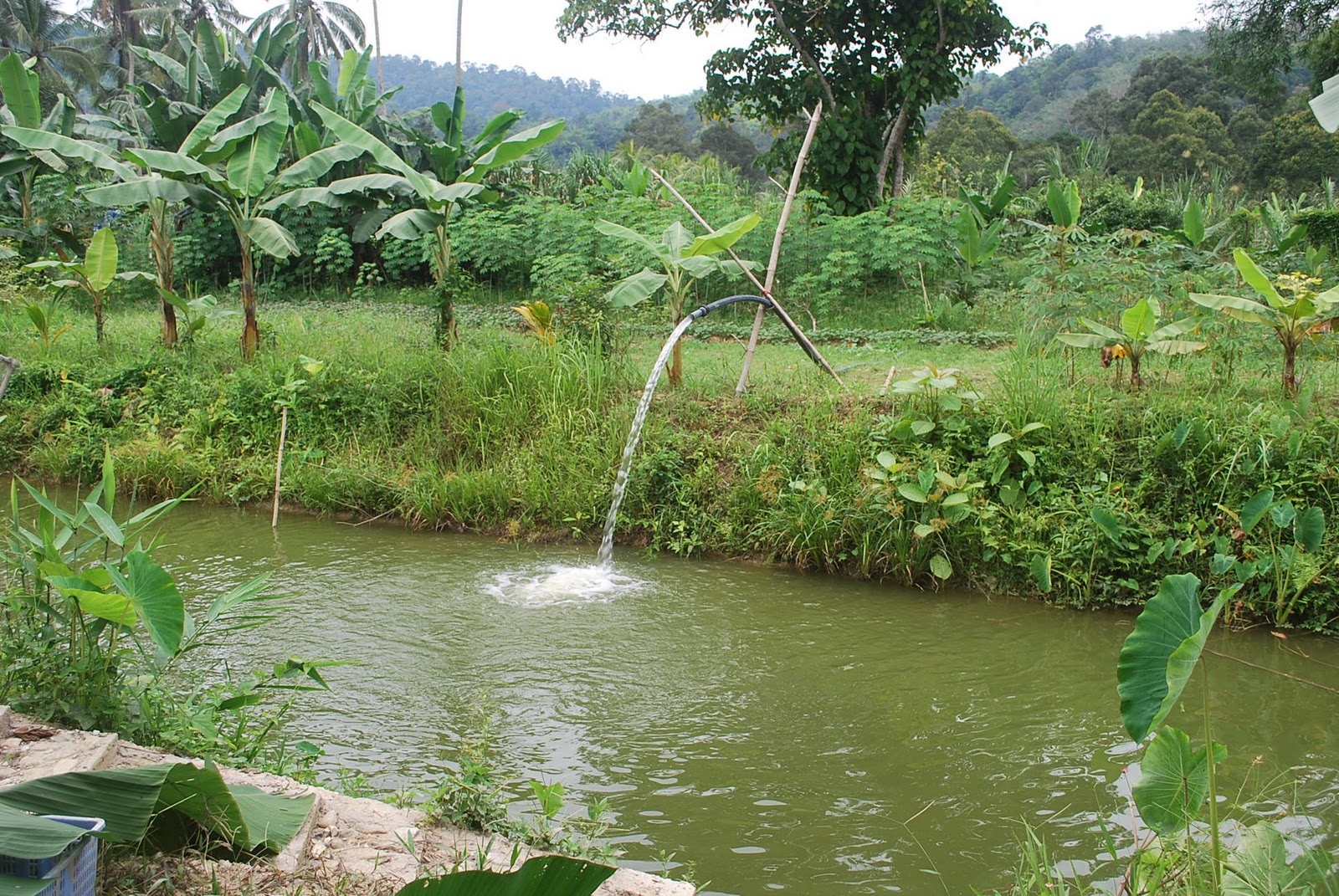
Pumping water for flushing

To begin with, utilizing the natural contour of the land as a basis, I deepened and widened the dried-up streams, following its flow, thus creating fish ponds that look like a small river on the farm.  The pond bottoms are not cemented but have a high content of sand, which was uncovered during the excavation process.  With the constant feed of water from clean upstream stream, the water quality is good and does not emit a noxious smell that is often associated with stagnant ponds.  Every quarter, I would do a major flush, pumping water from Sg. Lui into the pond, in effect renewing the water.
I use fish pellets that do not have land animal content in them, supplementing it with vegetation such as tapioca shoots and keladi shoots, to feed the fish.  Alhamdulillah, with the source of the water being from a nice clean river, there are also lots of small fresh water shrimps which the fish also happily consume.  These shrimps have taken residence in the pond so they continue to breed in there providing an on-going source of natural food for the fishes.
I am happy that my guests for Aidil Fitri 2010 open house gave favorable reviews on the taste of the fish.  For now, I have not put the fish on the market as I would like to increase the population as well as letting them grow to a good size of about 800g to 1 kg per fish.

07 Mar 2011

Eating Well – Chicken Eggs

I am convinced that when we tinker with Mother Nature, there are consequences.  Take a simple item like chicken eggs.  If the hen layers have foreign elements injected into their life such as antibiotics, processed feed containing other than plant-based components, it is bound to end up in the chicken eggs.  The impact in humans may vary from person to person, depending on what we a susceptible to and knowledge on the impact is also very much a mystery.

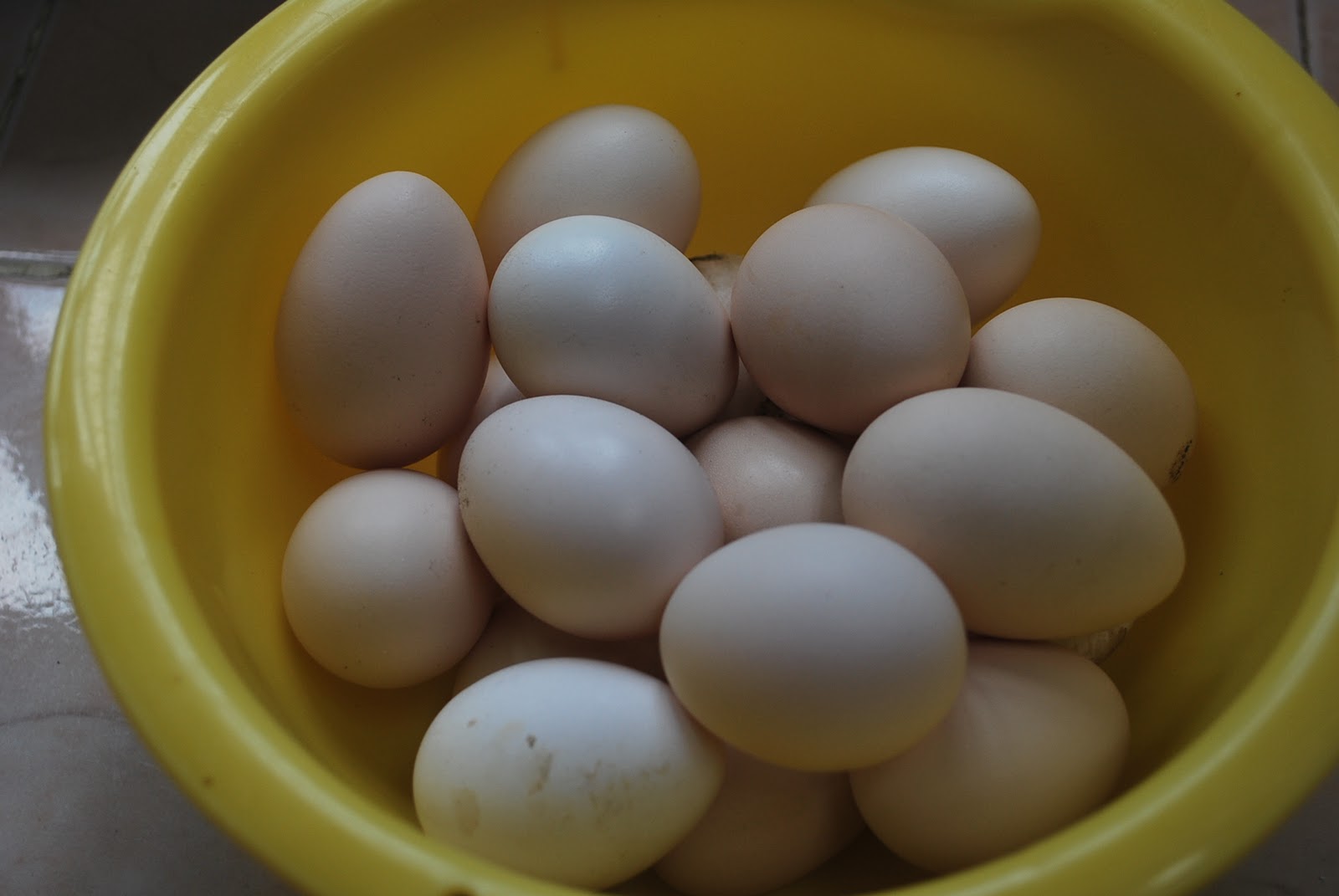
With this in mind, I try to improve on my well-being with my own production of chicken eggs.  The eggs may not be as big as those available at supermarkets but to me, they are definitely healthier. At least I know what goes into the production of these eggs.
Since I am not able to eat the chicken that I raise, I only consume the eggs.  Somehow, I am unable to reconcile to slaughtering my own chickens, after all, I have named many of them.  At the farm, the average number of eggs produced per week is 22 but I hope with the new chicks born on the farm, the production can increase in the near future.


The chickens happily run around the farm ( or at least, that is what I assume), pecking at vegetation amd those insects and worms that seem to be tasty to them, hence my aversion and self-implemented ban to any chemical pesticide and weed killers usage on the farm except on the outer fence of the farm.  Hence, I have to resort to more creative ways to control pests and weeds.